
Briefings
AI That Knows Your Business
An Executive Briefing
For the executive who will not read the technical reference. Worth half an hour and a coffee, on a quiet morning.
Executive Briefing No. 01 • 14 Pages
The Executive Briefing is the first publication from MultipleWorks. It argues a position. It is written for the executive who is being asked to make AI decisions for their organisation but does not want to become a technologist to do so.
The Architecture Briefing takes the same argument into implementation. This document argues the strategic position. It has been written to be read on a quiet morning, in half an hour, with a coffee.
Free to download, share, quote, and screenshot. Citation appreciated.
Chapter 1
The question every CEO is asking about AI
Past the early hype, the question executives ask in private has narrowed to one. Why doesn’t this thing know what we know? The deployment was meant to give the organisation a capability it could trust. It produces answers that are technically competent and substantively shallow, and the people on the receiving end can taste the difference.
The temptation is to treat this as a tooling problem. A different model, a different platform, a different vendor, a different prompt. None of these is the answer, because none of them addresses what is actually wrong. The system does not know your business. Until it does, no choice of tooling makes a material difference. The problem is not which AI you bought; it is the choices that determine what the AI is built on, what it has access to, and how the work it produces is governed inside the organisation. Those choices are not technical. They are decisions only the executive can make.
Most enterprise AI strategies are runtime strategies in disguise. They optimise for which model to call, which framework to adopt, which cloud to deploy on. The decision that actually matters is none of these. It is the question of what knowledge the system has access to, who owns that knowledge, how it is governed, and how it survives the next vendor pivot. That decision is rarely made by the strategy. It is made by default, by the order in which procurement decisions land. Two years later the organisation discovers it has not built a system at all. It has built a set of vendor-specific configurations, reproducible only by repeating the work that produced them.
This briefing is for the executive who has to make those decisions without becoming a technologist. It does not name vendors. It does not describe products. It puts forward a framework, and a small set of choices the framework forces into the open, that determine whether the next two years of AI investment compound into an asset or evaporate into reconfiguration. The technical reference behind this briefing exists for the people who build the system; this document exists for the people whose decisions determine what gets built. Worth half an hour and a coffee, on a quiet morning.
Chapter 2
Four kinds of knowledge, not one
When people talk about getting AI to know their business, they usually mean one thing: the documents, policies, and data the organisation already holds. The AI should be able to draw on these and answer questions accurately. This is true and useful, but it is one quarter of the picture, and the other three quarters are where most enterprise AI deployments are getting it wrong.
An AI system that works in your business has to handle four kinds of knowledge, each of which behaves differently and needs to be treated differently. The first is what the model already brings, the knowledge it had before it ever met your organisation. The second is what your business knows, which is broader than people assume and contains several distinct sources of truth that are not interchangeable. The third is what makes the AI act in a way that each individual using it recognises as theirs, the configuration that lets the AI work alongside the person rather than in spite of them. The fourth is what is true right now in this conversation, this document, this meeting, which is short-lived by definition.
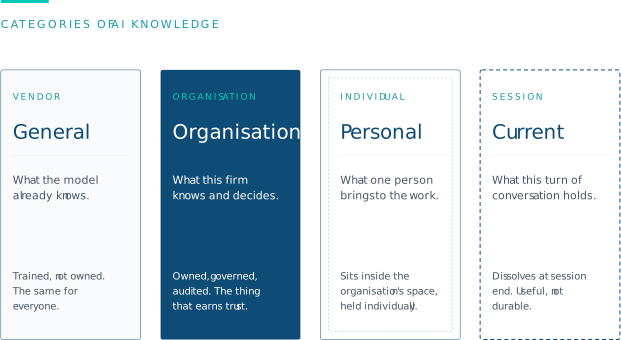
These four are owned by different people, governed by different rules, and updated on different cadences. The model’s knowledge is the vendor’s responsibility. The business’s knowledge is the organisation’s. The personal knowledge is held by the organisation but on behalf of the individual, not over them; the difference matters more than it sounds. The current context belongs to the moment. Treating all four as one undifferentiated pool, accessed through one mechanism, is the failure mode that produces enterprise AI deployments that work in demos and disappoint in production.
The third category is the one most enterprises miss entirely. Without it, the AI feels like someone else’s tool. Reports come back in a flat corporate voice that the people receiving them can taste, the recipient rewrites them before sending them on, and the people who would get most value from the system route around it to a personal account on a consumer tool that has been quietly building up context about them for months. This is the shadow AI problem, and it is not a security failure caused by users behaving badly. It is a failure of the corporate system to know the people it is meant to serve. The system that does not know the individual produces work the individual will not put their name to, which is a quieter problem than a security incident but a more expensive one.
The four categories are how this document thinks about what AI needs to know. Everything else in the briefing follows from this distinction.
Chapter 3
Three layers, with governance running through all of them
Once you accept that AI has to know what your business knows, in all the variety of forms that takes, the question becomes how to build the system that delivers it. The answer is three layers, and the place that most organisations skip is the middle one.
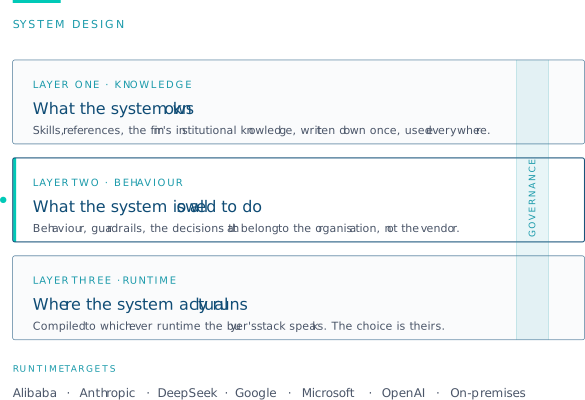
The first layer is what the system knows. This is the four categories of the previous page, made operational. It is where the documents, the systems of record, the knowledge graphs, the personal context, the session memory all live. It is the layer that handles knowing your business, with all the variety of sources that the previous page’s categories opened up.
The second layer is what the system is allowed to do, written down in a way that is independent of any particular vendor’s tools. This is the layer most enterprise AI systems do not have. Without it, what the AI is allowed to do gets written directly into a vendor’s product configuration, where it cannot be audited cleanly, cannot be moved when the vendor changes their format, and cannot be governed across multiple vendors at the same time. The middle layer is the one that lets the organisation own its rules rather than rent them. It is also the layer that the EU AI Act and similar regulations are increasingly asking organisations to demonstrate, even when the regulation does not name it directly.
The third layer is where the system actually runs. This is where requests get routed to the appropriate model, where the rules from the middle layer are enforced at the moment the AI does something, and where the record of what happened is captured for audit and review. Most enterprise AI tooling sits at this layer or below. The work of the previous two layers is what makes this layer useful rather than merely active.
Running through all three is governance: the audit trail, the policy enforcement, the regulatory mapping that determines whether the system can be deployed at all. Governance is not a separate layer because it is not localised to any one of the three. It is the property that has to hold across them.
The system that does not have all three layers, with governance running through them, is not a system. It is a configuration that happened to work once. The next change will require rebuilding it, and the change after that will require rebuilding it again.
Chapter 4
AI knowledge needs an editorial process
Anyone who has worked inside a publishing house knows the story of why it takes so long to get a book to print. The author writes. An editor reads, suggests, revises. A copy-editor checks every fact. A lawyer reads the manuscript for libel. A proofreader catches what everyone else missed. Months pass. The book that emerges has more than the author’s name on it; it has the integrity of the process that produced it.
Different content gets different treatment. A tweet has no editorial process at all, which is part of why tweets are believed by no one. A blog post has a self-edit. A long-form magazine article has a senior editor and a fact-checker. A peer-reviewed scientific paper has the most rigorous version of all. The stages are the same in shape; the rigour scales with how much the content matters.
Enterprise AI today treats every piece of knowledge it uses like a tweet. Someone configures the system, the system goes live, the configuration sits there until something breaks. There is no author with their name on it. There is no review before it ships. There is no record of what changed, when, by whom. There is no feedback loop from the people using the system back to the people maintaining it. The result is what you would expect: knowledge assets that decay silently, that no one notices have decayed until they produce a wrong answer in a meeting that mattered, and that no one knows how to fix because no one knows who owns them.
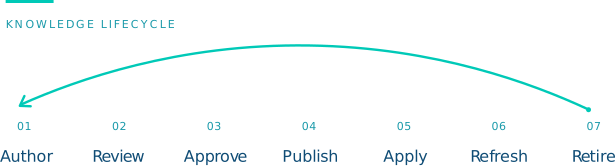
The way this should work is straightforward, and the executive who has run a serious publishing operation, a regulated product line, or any function with named accountability will recognise it on sight. Someone authors. Someone else reviews. Someone with the right authority approves. The version is recorded. The asset goes live. Feedback comes back from the people using it. The asset is revised, or eventually retired. Seven stages, the same seven that a publisher has used for two centuries, applied to the knowledge inside an AI system.
The mature enterprise AI deployments of the next five years will be the ones that build this editorial process. The ones that do not will discover, over the same period, that what they bought is decaying in production and that no one is responsible for noticing. The difference between the two outcomes is the difference between AI as a managed asset and AI as a one-time deposit. The first compounds. The second does not.
AI as a managed asset compounds. AI as a one-time deposit does not.
Chapter 5
Four properties hold trust together
The way this is built is judged by what it holds together. For an enterprise AI system to be trustworthy, four things have to hold simultaneously. None of them is sufficient on its own. All four are necessary. Most systems shipping today hold one or two and discover the missing ones in production, by which time the cost of fixing them has multiplied.
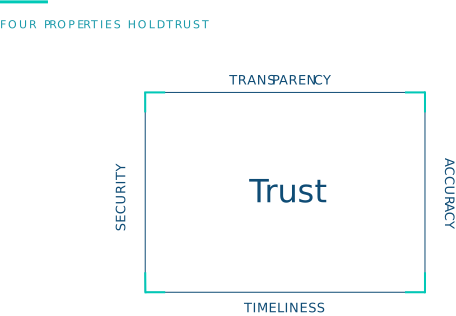
Transparency. The system takes a position the prevailing market does not. The AI is honest about itself. When it is the one speaking, the recipient knows. When it executes a task, there is a clean record of what it did, with what authority, drawing on what knowledge. The system does not, however, mandate that the human disclose when they have used AI to help with their own work. That choice belongs to the person, not to the system. The system makes disclosure possible by capturing the metadata; the person decides what to disclose. Put precisely: the AI is honest about itself; the human is accountable for their work. The two responsibilities do not merge.
The AI is honest about itself; the human is accountable for their work.
Accuracy. What the system tells you has to be correct, and what counts as correct depends on what was asked. Different categories of knowledge stay accurate by different mechanisms, and the system has to engage all of them rather than picking one. The single failure mode in current deployments is treating accuracy as one problem with one solution, which produces systems that are excellent at one kind of question and unreliable at the others.
Timeliness. The data the system uses has to be current enough for the question being asked, and what counts as current is different for different kinds of knowledge. The HR system updates in real time; the regulator’s published rules update on a different cadence; the individual’s personal context updates whenever the individual updates it. A system that supports all of these cadences without conflating them stays useful. The most common failure in enterprise deployments is treating organisational knowledge as if it updated on vendor cycles, which produces stale answers to questions the underlying system already had right.
Security. The boundaries hold. Security in this design is not the wrapper around everything else; it is one of the four properties, alongside the others. Treating security as the dominant frame produces systems that are secure but opaque, or secure but stale, or secure but inaccurate, none of which is trustworthy. A secure failure is worse than a system that was never deployed, because it has consumed the budget, the patience, and the political capital that the next attempt would need.
Trust is what these four produce when they hold together. It is also what is destroyed when one of them was missing all along and only became visible at the wrong moment. A trust incident is not a security incident; it is a discovery that something the system should have held was not being held. The work is to design for all four from the start, because by the time a trust failure has happened, the cheapest option is rarely on the table.
Chapter 6
Five decisions, made deliberately or by default
Every organisation running AI is making the same five decisions. The only question is whether they are made deliberately by leadership or by default, by the order in which procurement decisions land. The first reason to make them deliberately is that the cost of remaking them after they have been made by default is several times what it would have cost to make them right the first time. The second reason is that they are not technical decisions. They are decisions about what the organisation is willing to spend, what it is willing to depend on, and what it is willing to live with for the next ten years.
The first is where the data lives. Vendor-led thinking pushes towards a single region in a single cloud, usually US or EU. The counter-position is that an organisation operating across Hong Kong and the region will be running across multiple data residency boundaries whether it plans to or not. The decision is whether the organisation absorbs that complexity in design or discovers it in compliance later.
The second is which models and vendors the organisation is willing to depend on. The default is to pick one, usually whichever the existing cloud relationship favours. The counter-position is to design for two or three from the start, with the system absorbing the cost. Single-vendor lock-in is cheap to start and expensive to unwind. The first vendor pivot reveals the price.
The third is whether on-premises is part of the picture. The default is cloud-first, on-premises as exception. The counter-position is that in regulated industries, on-premises remains the baseline for sensitive workloads, not a fallback for legacy systems. Cloud-first thinking applied to a workload the regulator expects to see on-premises produces deployments that fail their first audit.
The fourth is when governance is designed in. The default is to bolt it on after the system is running. The counter-position is to design audit, policy, and traceability in from the start. A serious enterprise in Hong Kong operates across the intersection of multiple regulatory regimes simultaneously, the PDPO, HKMA expectations, mainland China data law, the EU AI Act. No single cloud platform’s governance layer is built to map a system’s behaviour against all of these at once. The regulatory environment is a mesh rather than a wall, and a system designed for one regulator at a time will fail its first audit against the others. Retrofitting governance against the mesh costs several multiples of designing it in, and the EU AI Act in particular is unfriendly to retrofit.
The fifth is how the organisation handles personal knowledge. The default is that the organisation owns everything that touches the system. The counter-position is that personal knowledge (the configuration that lets the AI work in a way the individual recognises as theirs) sits inside the organisation but is held under custodianship rather than ownership. This decision determines whether the organisation’s best people use the corporate AI or route around it.
These five decisions are not made by the AI strategy. They are made by the procurement, the regulatory pressure, the existing vendor relationships, the cloud commitments, the security incidents, the budget cycles. Made deliberately, they hold for years. Made by default, they cost more to undo than they did to make.
Chapter 7
Ninety days, then twelve months, then a decade
Most executives reading this are not at day zero. The pilots are running, the contracts are signed, the procurement cycles have left their marks. The ninety days that follow apply at any point in the deployment cycle. The further along the organisation, the more its prior choices are costing it, and the faster the work pays back.
The work of those ninety days is to make the underlying choices rather than buy the next tool. Run the four categories of knowledge against what the organisation already has and notice the gaps. Decide which lifecycle stages will be operationalised for which classes of asset. Make the five decisions explicitly, with the reasoning recorded. Write the decision record in language that survives leadership turnover, vendor changes, and the next strategy refresh.
Three written artefacts come out of those ninety days. A decision record naming each of the five decisions and the reasoning behind it. A knowledge inventory mapping what the organisation has against the four categories. An architecture brief describing the three layers in enough detail for a competent team to build against. The pilot that follows arrives later than the one built without them, and lasts longer.
The build that follows is straightforward when the underlying choices have been made. It is what consumes the budget when they have not. By the end of the first year, the organisation has a system that knows its business, can be audited cleanly, and is owned in the proper sense of the word: not rented from a vendor whose roadmap will diverge from the organisation’s the moment it stops being convenient.
The decade that follows is where the AI investment compounds, or does not. If the work in the first ninety days was done well, every subsequent use case is cheaper than the one before it, every audit is easier, and every vendor change costs less. If the work was skipped, the opposite is true.
The technical reference behind this briefing exists for the architects who will build what the executive decides; this document exists to help the executive get those decisions right.
Mark Goodchild is Founder and Principal of MultipleWorks, a Hong Kong consultancy engaged by executive teams on complex, high-stakes problems across Asia Pacific and internationally, from the first decision through to delivery. He spent eleven years at EY as a Director leading digital and emerging technology consulting across the UK and Asia Pacific. Reachable at hello@multipleworks.com.hk.
Free to share, quote, and screenshot. Citation appreciated.
Suggested citation: Goodchild, M. (2026a). AI That Knows Your Business: an executive briefing. MultipleWorks, Hong Kong. Available at multipleworks.com.hk/briefings.
© 2026 Mark Goodchild. Published by MultipleWorks. Some rights reserved under Creative Commons BY-ND 4.0.
v1.1 · May 2026
Acronyms
PDPO - Personal Data (Privacy) Ordinance, Hong Kong
HKMA - Hong Kong Monetary Authority
EU AI Act - European Union Artificial Intelligence Act